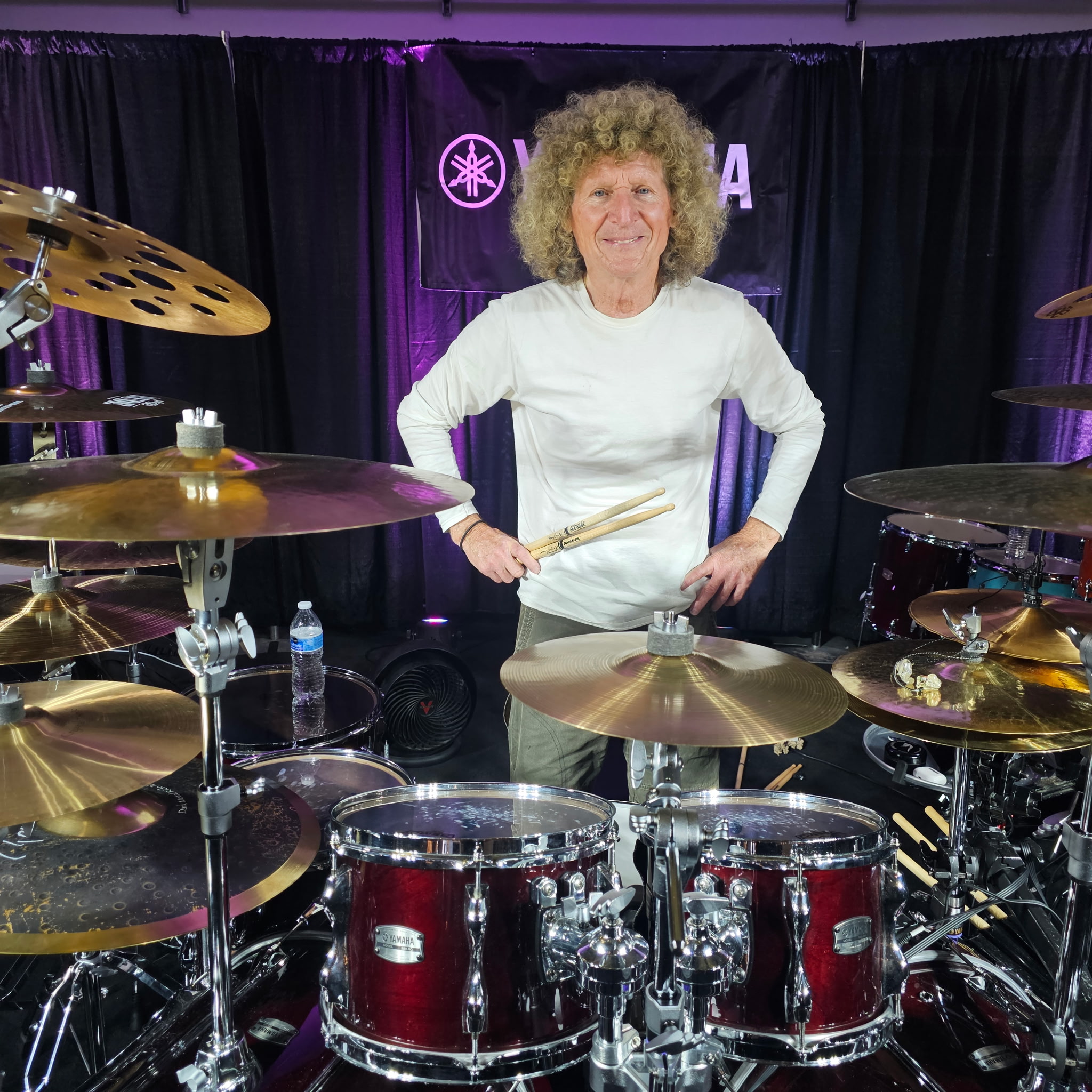
A lot of you know legendary drummer, Tommy Aldridge, from his work with bands like Gary Moore or Pat Travers, but in metal, if you will, he has played, recorded, and toured with bands like Ozzy, Whitesnake, MARS, Motörhead, Thin Lizzy, and many, many others. We had the chance to sit down and talk with him last night about some upcoming clinic dates in California, and lots of other drum-relative stuff! It was an absolute honor to have the opportunity to conduct this interview.
Tommy Aldridge Remaining Drum Clinic Dates – June 2026:
- June 19th in Sacramento, CA @ Skip’s Music
- June 20th in Fresno, CA @ Bentley’s Drum Shop

Tommy Aldridge Interview:
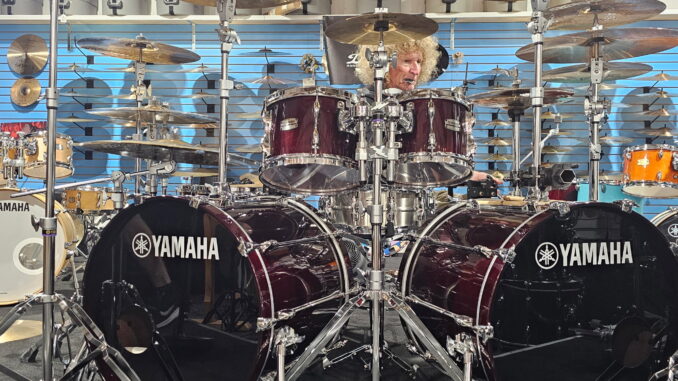
SDM: I know that for a long time you’ve been endorsing Yamaha, I believe since around 1982, and, Paiste since about 2003, and you also endorse Promark, Remo, and Danmar. Is Danmar still one of your endorsing companies?
Tommy: I haven’t had any contact with them in a wile, but I have several of their beaters and still use them. You just have a tendency of going through kick drum heads a lot… a lot quicker when you use a wooden beater, so I don’t use them live for that reason. I was always blown out. It’s a pain in the butt, even if you have two bass drums. If you blow one out in the middle of a show, it’s not like switching out a snare drum, if you go through the snare head you can do that transition pretty seamlessly, but it’s hard to with kicks. I actually ended up designing my own beater.
SDM: I hear you. I’ve been playing 43 years, so I feel ya.
Tommy: Wow, wow! Long time. That’s cool, man, that’s cool, yeah. And, like me, you haven’t managed to outgrow it, huh.
SDM: Never will, never will. Tommy, I know this interview is not about me at all, but I’m a better drummer now than I’ve ever been. I play 3 times a week on Twitch, I have for about 2 years now. I play for, like, an hour or two, three times a week, and I have a list of about 600 songs that people pick that I play from memory. People throw subs and bits, and all kinds of tips. I make like $200 to $700 a month just playing in my fucking dining room. Excuse my French.
Tommy: Wow. Well, that’s awesome, Ian! It’s good that you can say that you’re a better drummer now than you’ve ever been.
SDM: Yes. Agreed.
Tommy: That’s amazing?
SDM: It’s pretty strange, I would never have guessed, but here we are. So when you guys book a clinic tour like this, how do you approach it? I mean, how do you prepare for the drum clinics themselves?
Tommy: Well, I don’t really look at this one as a tour, because it’s only really 3 or 4 dates, but, what I’ve done in the past, usually I’ll come in off a tour, and so I’m kind of raring to go and pretty tuned up. I’ll take a week or so off and try to time a clinic tour to come at… not a couple, two or three weeks after I get home from a tour, so that I’m sharp, and you’ve been on the stage and… and stuff, because you can rehearse and rehearse. I’m sure being a drummer for 43 years you’ll agree, rehearsing’s one thing, getting on stage and doing what you’ve been rehearsing is something altogether different. It is in my case.
SDM: Yes Sir
Tommy: I have kind of a physical style, and being self-taught, my playing style isn’t a real logical curriculum, because I taught myself. So, it wasn’t really curriculum-based, with the… you know, you start with a single-stroke roll, and then you go to a double-stroke roll, and then you get into the compound rudiments, paradiddles, and things like that. So, because I’m self-taught, I just worked my way through a rudiment book, and stick control book just messing around. And by the time I got into the music that really accommodated me most emotionally, I ended up not using a whole lot of the stuff that I’d learned, because it’s, for one reason or another, a lot of what you play is very genre specific.
To answer your question, in this case, I’ve been working a lot more. I’ve been trying to do some of my bucket sub lists here in my drum room, trying to get it up to speed where I can do all my recording here, rather than rehearsing here and working up tunes and dumping stuff onto my thumb drive and sending it to the producer or guitar player, or my fellow guys that were working on the material, and back and forth, because we’re doing it all virtually or remotely. So, one of my bucket list items is just trying to get my studio here at home set, where I can do everything here. Where I can record world-class stems and things like that, and do some video/live streaming as well. So that’s what I’ve been trying to do.
To be able to play them seamlessly, one after another, doing 45 minutes non-stop balls to the wall, you have to have some stage stuff going, and so I’ve been trying to replicate that in my drum room. It’s been a lot of fun. You know, working up a sweat, coming in and running through my little clinic, running over three or four times in a row. And so, this really isn’t a tour, because, again, it’s only four clinics, but just trying to get up to speed on that stuff.
Even though I’m getting ever older, there are expectations out there that I struggle a little bit with every passing year to be able to meet, and I don’t want to go out there when I shouldn’t be out there. I want to make sure I don’t ever subject anyone to that! lol When an athlete hits the wall, the coach knows it before the athlete does, but the athlete knows it soon thereafter because he gets the elbow, if you know what I mean. And my drumming is not a really an athletic endeavor, but there’s a lot of biology involved. Especially if you have a real physical style and you play music that is something that you grew up on. It’s like having a dragon tattoo that wraps around your body and comes up around your neck and partly onto your face when you’re 22, and then when you hit 70, you’re thinking, hmm, maybe I should have maybe just done a small lizard? That’s maybe a bad analogy, but… I just want to be sure that I’m doing as good a job as I’m capable of doing. I do my due diligence in my drum room before I go out and do them after having not been on the road.
SDM: Oh, that makes perfect sense. Absolutely. So, I’ve seen lots of drum clinics. I’ve seen some guys that just sit up there and basically solo for the whole time. I’ve seen some guys that actually talk about rudiments, or, like, some of the things you had just mentioned before, paradiddles, flams, rolls and all that, so… what kind of topics will you be covering during the clinic? How will it go for those that are attending, and do you think you would adjust the content of your clinic based on what it looks like when you get there and see the attendees and their ages?
Tommy: Good questions, Ian. That’s really good questions, man. Thoughtful questions. I try to be fast on my feet, so to speak, no pun intended. I kind of let the room determine that. I mean, if I was a real die-hard drum corps dude, and had the kind of technique that, like Dave Weckl or Thomas Lang or somebody like that, I may approach it differently.
SDM: Okay. Fair.
Tommy: That’d be the first thing I’d want to do, is show off and just humble everybody, and humble them into oblivion. I don’t have that kind of vocabulary. I don’t make any bones about it. There’s not a lot of rocket science involved. I do a lot of stuff outside of what I’m really known for, that I enjoy doing, and some odd-time stuff and things like that. Stuff that’s a little bit more technical, but really my bread and butter stuff is what people know me for, so when people come to see me, especially in a situation like a clinic, I try to share, and just do my best to not really inspire anyone, because I’m not so presumptuous to think that I’m that inspirational.
SDM: Gotcha. I’m kinda Jelly.
Tommy: I suppose I just try to encourage people to get into the drums and drumming, and just try to give them a view that I’ve developed over my incredibly long career. I don’t say it boastfully, I just say it as a blessing. It’s a bigger surprise to me. Usually, someone in my position, you have maybe 4, 5, 6, 7 years, maybe? You know, if you’re lucky, it’s almost like a professional athlete. It’s the only job I’ve ever had, it’s the only form of source of income I’ve ever known. So, apart from when I was a kid and I was mowing lawns, that kind of stuff. Don’t be jealous, dude, this isn’t about jealousy. I’m just a blessed guy. I mean, I’ve worked my butt off, but I know guys that have worked their butts off. There could be things about me that nobody’s ever heard of, so life’s not fair, nor is salvation.
SDM: It is a blessing, and you’ve been an inspiration for decades.
Tommy: What I try to do is let the room call the shots. BUT… if somebody asks me to do a, uh, a 13 with a 3-note triplet ostinato on the left, I’m gonna say, dude give me a break. I can be a dick and say, yeah, I can do that. Will you do it? No, I won’t do it, but I can do it. You know, there’s so many things. You get really, really sweet people at these things, and just like the internet, well, not just like the internet, just like all the platforms out there, the social media stuff, where you’ve got the weasels that sit at a keyboard and vilify people that really should be edified, and put people on a pedestal that really should have no one’s attention. So, I struggle with a lot of things when it comes to our human nature. I have the same human nature, and when you have someone that can tear somebody down, and whittle somebody down that really deserves better, and do it anonymously, with no accountability, it makes the hair on the back of my neck stand up a little bit. So, what I try to do is be kind, like people have been to me, and give something, or try to share something with young and up-and-coming guys that’s encouraging. I mean, if you go on YouTube these days, man, it’s humbling. I mean, I see the fundamental forces of the universe, like gravity defied on a bar-by-bar basis. These so-called influencers… lol. It makes me want to go cut my arms off! So I can imagine what it must be for young guys coming up. And even though it’s a huge resource, when in my day, I had to spend three weeks trying to find out what Joe Morello was doing on a ride cymbal with Take Five, trying to work it out as a young kid.
SDM: Well, let me let me let me go back a minute and first of all say that you’ve been you’ve been an inspiration to lots of people for a long, long time, and the fact you’re still doing it, and still enjoying it, and still out there, doing these clinics, and small tours and shows, and whatever else, is even inspirational still to this day.
Tommy: Well, I appreciate that, but my primary goal, to answer your question, is I just try to encourage people that have an interest in this, encourage them in a way. Try to show them and convince, or give them some hope, or some light around the corner, that they don’t have to play a blast beat at 220 BPM to be successful. That you don’t have to have the flow of Larnell Lewis, or the backbeat of John Bonham to be a successful drummer. Just try to encourage people with what my experience has been. There’s been some battles, absolutely. If it was easy, everybody would be doing it, and if it was easy, nobody would want to.
SDM: This is off topic, but I was just up in Toronto this past weekend with my wife for anniversary, and I saw a band called Goose. I don’t know if you know who they are, they’re amazing.
Tommy: Happy Anniversary!
SDM: Thank you, sir. I stopped at the Queen’s Park in Toronto, at the Legislative Building, which was where they took the album art for moving pictures, and I stood on those steps this weekend and took my photo on the same steps!
Tommy: Well, that’s pretty awesome, considering that Geddy and Alex decided, along with Annika, to kick it back up. That’s good, good timing. Yeah.
SDM: You also mentioned Larnell Lewis. Uh, Larnell is one of my favorites, and I do play some Snarky Puppy on my stream as well. Another one is Gavin Harrison. Those are, like, my top two favorites right now, actually, that you mentioned Larnell. Those guys are alien.
Tommy: Yeah, those guys are bulletproof, man. Those two guys are crazy. I did a thing a couple of years ago at PIT in Los Angeles with WEC, and that’s when I first met Larnell, and it was before he was starting to get the momentum, before any of the snarky puppy stuff or anything, and he was pretty much unknown. He owned the place. It was crazy.
SDM: Yeah, he’s phenomenal, and I love the fact that Snarky Puppies albums are all just live, like, that’s it. They go into the studio, they record it live, what you get is what you get. I mean, it’s just insane.
Tommy: It’s insane what they get, man! I live up in the San Fernando Valley, I don’t know if you know where it is, it’s a couple hours north of Los Angeles. It’s just above Santa Barbara, and it’s kind of a horse ranch and vineyard area, and I’ve lived up here with my wife for decades. There’s a little room that I’ve been using as a drum room here, and I’m trying to get away from it so I can use my own drum room to do all the real tracking when someone sends me the stems. I do several albums a year of drum tracking, and I just don’t have the infrastructure to do it in my drum room yet. I’m getting really close! This little drum room that I’ve been using is called Joel Jacks Recording, and Snarky Puppy has been doing all their horn section stuff in there for years. It’s just a small room, but it has a really, really high ceiling, and they don’t track the rhythm section and stuff in there, but all the horn parts have been down there for the last couple, two or three.
SDM: Yeah, very cool.
SDM: Regarding your past and, I guess, current playing techniques, everybody knows you for your five pattern, “the fives.” You know, whether you’re using your sticks or your hands, you’re getting into it, and you’re punching the drums and punching the cymbals, which I love, because I’ve done it. You get so into the music sometimes, you just stand up and punch something. But when you first started doing that, and I’ve seen you do that, actually, live, Tommy. I was about 14 or 15 at the time. I’m not sure if it was with Whitesnake or if it was with Ozzy. I think it was with Whitesnake on the Still of the Night Tour, or maybe it was when you were on tour with Great White and Whitesnake, it might have been the Once Bitten Tour, but I’ve seen you do it.
Tommy: Great White, yeah, Great White supported us on those first few runs, yeah.
SDM: Since then, I’ve always wondered… was there anything in particular that sparked that?
Tommy: It came about when I was a kid. I started playing when I first became interested in two-bass drums when Ginger Baker was on it. I’m 75. I mean, there wasn’t anything really played on two bass drums that I thought… well, I guess Louie Bellson played some stuff on it, but I never heard any of it.
I looked at drum catalogs when I was a kid, like most young guys were looking at Playboy and, Penthouse and stuff. My mom would come in my bedroom, and I’d be under the blanket with my flashlight, and she’d bust me, but I wasn’t… lol. I was looking at drum catalogs.
It was in the fold out of that big Premier catalog at the time, there was this British drummer, and he had two bass drums, but I said, wow, that looks cool. And so, I borrowed one. I had a friend who used to come over and bring his kit in my little rehearsal shed in the back, and he would set the drums up facing one another and just go ballistic. Eventually, he lost interest, and when he came to get his kit, he let me keep one of his bass drums, and I just started messing around.
Before I started playing it, I switched back to a left-hand setup, I just reversed everything, and I thought, well, I’ll do this for a while, because it would help my left foot to come up to learn how to play a bass drum pedal, because the Hi-hat action was completely different. That was just my stupid stinking thinking as a kid.
SDM: Yep, yep.
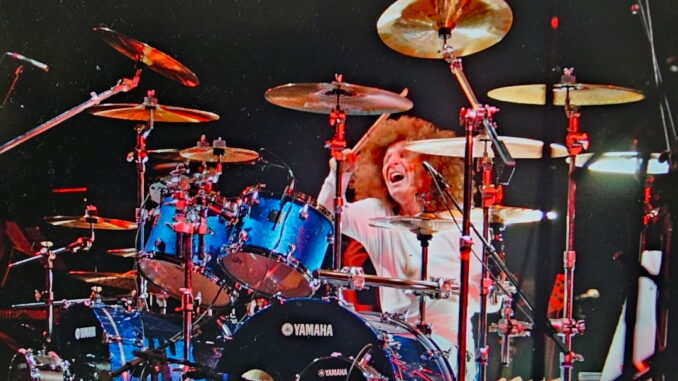
Tommy: I just started messing around the rudiments, just like I figured, well, if the rudiments for… say, like, a paradiddle, it teaches left-right independence, and it teaches leading at a double paradiddle, or a paradiddle-diddle, you can alternate with the right hand, and it comes around, and lead with the left hand. So I said, if it’s good for my hands, it’s gotta be good for my feet.
SDM: Exactly.
Tommy: So, that’s what I started doing. When I heard Ginger Baker and all these guys, or John Bonham, only using a single kick, I thought I had been doing a triplet, where I was doing a triple.
SDM: That makes sense.
Tommy: My goal was trying to find a way to play things that sounded the same as patterns that everybody was playing, but trying to find a way to do it where it sounded different, and heavier, and bigger. I’m 5’ 9” and a half, and weigh 137 pounds. I’ve spent my whole career trying to make myself sound like I’m 6′ 4”.
My Dad was not much of a supporter. I was a drummer for decades before my dad ever knew, because he thought that musicians were, the cretins of the universe, and they were either drug addicts, or just idiots. He was a very good father in many ways, but he was pretty single-minded in his approach to life, and it was his way or the highway. My mom, on the other hand, was very supportive.
The hand thing, the first person I ever heard play drums with their hands was this guy called Frosty. Saw him with Dave Brubeck and Joe Morello, he was playing hand solos and stuff I had never heard. I never saw any of that. It was this guy, Frosty, was the first guy that I ever saw playing with his hands. Well, I’ve been playing with my hands in my drum room, because I would put towels over my tom-toms and my snare drums, and put pillows all around my kick drum, and I would still rehearse when Dad was there, so he couldn’t hear me in the shed way back behind the house where we kept the lawn equipment. The necessity was the mother of that invention. It allowed me to rehearse when my dad was home.
SDM: That’s awesome.
Tommy: Frosty played with Lou Michaels.
SDM: It’s great to watch, man. I love watching it over and over. I can never get sick of it, because I just love the intensity, and I can see the love for the drums when you stand up, especially, and start punching those cymbals! Lol
Tommy: It breaks my heart to do it, because it’s so abusive to those beautiful works of art. But, yea, I was just with Kelly Paiste for a couple days, doing some clinic stuff.
SDM: They were made to get beat up on, man.
Tommy: They were, yeah, but boy, I tell you, I hate to see a beautiful one that doesn’t have a couple fingerprints on it. Lol
SDM: Kelly is great. So I’m going to move on to this next question here and then just a couple more.
Tommy: Jesus, she’s a princess.
SDM: Old school recording, analog, tape vs new school recording. You can produce a record in your bedroom with a computer. I know there’s pros and cons to both sides. If you could go into the studio to record a record tomorrow, what would you rather do? Would you rather take advantage of the new materials and software, or would you rather go back to do it OG tape?
Tommy: If I had to do it tomorrow, I’d have to go the new way, because I wouldn’t have any time to rehearse, because the other way, it’s like you mentioned Larnell and Snarky Puppy, the way those guys record, that’s how it should be, but in order to do that, you have to know the material, you have to know the song, you have to be able to interplay with musicians. You actually have to be a musician rather than an influencer, don’t you?
SDM: I’ll rephrase the question. What if you were going to rerecord something that you know like the back of your hand?
Tommy: I love the studio, even though I’ve been deprived of playing on some of the most successful records that I’ve ended up touring for. I was living in England and working with Gary Moore, and I passed on them because I knew Ozzy from his Black Sabbath days, and I was in a different place. I was working with Gary, who happened to be signed to the same label, again, so they were trying to pimp their own artist guys from their own, their own roster. It was weird. And the same with the 87’ Whitesnake record. I was hanging with John Sykes in L.A. and the Hollywood Hills at that time, and I couldn’t work a deal with Coverdale to do that record, and that’s how Aynsley Dunbar ended up doing it. I don’t have any regrets, it’s just the way things happen.
SDM: Before I go to the last question or two here, have you ever heard of a band called Car Bomb?
Tommy: Uh, I can’t say that I have…
SDM: All right, well, my other favorite drummer on earth is in Car Bomb. His name is Elliot Hoffman. He’s an alien, absolute alien. It’s like progressive death metal, but he’s truly unbelievable. Forget the fact that it’s death metal. He’s just mind blowing in every aspect.
Tommy: I’ll check it out.
SDM: This band goes into the studio, he records it all himself, and they’ll take one section of a song, and they’ll come up with 10 or 15 or 20 different ideas for that section. Next section, 10 or 20 different ideas, so on and so forth. Then they sit back and they listen to all those, they’ll pick their favorite parts for each section. Then they put it together as a song, and track it live in the studio that way. Which, to me, is absolutely fucking alien. I don’t know how they do it, I don’t know how they remember it all, but that’s how they write, and they don’t ever record or play live to a click. It’s just unreal.
Tommy: Well, you’re talking about a room full of savants right there! All those guys are savants to be able to do that.
SDM: And they’ve been together a very long time, which also helps, like you said. When you go into the studio with your first album, it’s usually the best because you’ve been with those people and those songs for so long. It’s the same thing with Car Bomb. They have the same members, they’ve been together since they were kids, and they’re still together now. They tour with bands like Meshuggah.
Tommy: Yeah. Depending on the genre, of course, that allows things that others wouldn’t, and to your point, I will go into my drum room here, and when I’m working on something, I’ll record a section and say, yeah, that’s probably what you use, and then I’ll go and I’ll do the section again and I’ll do it completely off the wall. The way that I think that nobody’s gonna buy it, the engineer’s gonna push a button and say, two beats in and say, you wanna save that for your solo record? But I’m surprised sometimes how many times those alternative approaches get picked.
SDM: Yep, yep, yep.
Tommy: When I don’t have a lot of input from a producer, from the band, or the person that I’m tracking for, it’s up to me. If we want everything to match, I have to have alternatives. I have to take it upon myself, because once the kit comes down, even if you put it back in the same place, it’s almost impossible to match it perfectly. So I try to cover as many eventualities as I can. I’ll record a chorus completely differently than I did in a previous take, or play the pre-chorus another way, so when I send the stems over, I can give them some alternatives.
They’ll often pick one of the more off-the-wall parts, and I just leave it up to them because they’re all parts I’d be happy with. Maybe I would have chosen that one, maybe I wouldn’t, but it’s their call. What it does is give you a chance, in a remote recording context, to be as responsive as possible to ideas or questions someone might have. It’s really hard—it’s kind of like recording in the dark.
SDM: Yeah, absolutely.
Tommy: When I was with Black Oak, we toured together countless times. The first major tour I ever did outside an international run was opening for Black Sabbath. That’s where I met Ozzy, Bill, Geezer, Tony—all those guys. We played twenty, thirty, maybe forty shows together on Sabbath’s first North American tour. Later, with Black Oak, we played California Jam. Deep Purple was there, Black Sabbath was there, David Coverdale was there. Ozzy was with Sabbath and I was with Black Oak. Those connections go back so far it’s crazy.
SDM: That’s amazing. Let me ask you this. I wish we had three hours because I’d love to talk to you that long, but I know you have to get going. I’m going to ask you a question, and I want your first instinct. What’s your favorite album you’ve ever tracked?
Tommy: It would have to be… well, there are a couple. Can I pick two?
SDM: You can do whatever you want.
Tommy: Probably Demons Down by House of Lords. It’s a really cool record. I used a carbon fiber kit, and David Thoener engineered and produced it. He’s an awesome studio guy. We recorded it at One on One Studios in North Hollywood, where a lot of huge records were made, including Metallica albums. I tracked the drums there using that carbon fiber kit. Check that album out. My second choice would probably be the live Pat Travers album Go For What You Know. Drumming-wise, it’s a complete opposite. Pat’s music has that pushy funk, bluesy, party-rock feel. Total night and day compared to the House of Lords record.
SDM: I absolutely will check it out. Here’s my last question. After these clinics and everything else you’ve got going on, is there anything you’d like to promote that’s coming up?
Tommy: I’ve got some things pending, mostly in Europe. A while back I worked with Adrian Vandenberg, Rudy Sarzo, and Ron Young from Little Caesar. We did an album together that was mainly for Europe, and we’re hoping to do some boutique shows toward the end of the year in places like Holland and Belgium. I’ve also got some remote recording projects coming up, along with a few offers to do some smaller, more intimate educational events—not really masterclasses, because I’m not a master at anything—but longer sessions where people can ask questions and spend more time talking drums.
It won’t just be sitting behind the kit playing. It’ll be an all-inclusive experience where we can talk drums, shells, hardware, sounds, and all the mechanical aspects of the instrument that I love. I’ve owned a lot of incredible handmade kits over the years—carbon fiber drums, custom snares, different rack systems—and one day I’d love to set everything up in a big room with a bunch of crazy drummers and just have some fun with it.
SDM: That sounds incredible. Let me know when it happens and I’ll fly out and stream it Live!
Tommy: I’m just trying to get some financing together. I’ve got lots of ideas.
SDM: Most drummers do. So… The Web and Social Media… What’s the best place for people to keep up with you?
Tommy: I really don’t do social media. I have kind of an anti-social media philosophy for the reasons we talked about earlier. There is an Instagram page related to some SceneFour drum art project that uses my name, but that’s not actually mine. I do have an Instagram account called RHYVUMS, but I honestly don’t even know what’s on it. I probably should pay more attention to all that, but I’m planning to clean everything up over the coming months as I start doing some streaming and putting together a proper online presence. The website will be aldridgeworld.com. Right now it’s just a shell while I’m gathering content for it.
SDM: That’s perfectly fine. I’m honored, Tommy. Thank you so much for taking the time to do this.
Tommy: Likewise. Thank you for your interest and for taking the time to talk with me. I really appreciate it, and hopefully we’ll cross paths in person again someday.
SDM: Absolutely. If I make it out to NAMM, or if you’re ever near Toronto, Buffalo, or Rochester, let me know.
Tommy: Absolutely. I’ll get your information from Greg.
SDM: Great. I’ll send it to Nelia as well.
Tommy: Awesome.
SDM: Good luck with the clinics. I’ll let my contact know if I can get someone out to Skip’s Music in Sacramento on the 19th. If not, let me know if there’s anything I can help promote afterward. I’d be happy to.
Tommy: That’s very kind of you. Thank you. It was a pleasure meeting you again, even if only virtually.
SDM: Next time we’ll have some history together.
Tommy: Yeah, we’ll hang out. Take care, man. Bless you.
SDM: Good luck, Tommy. Thanks again for your time.
Tommy: Likewise!
SDM: Thank you, Sir.
Update 6.30.26 Below:
Frontiers Music Srl is pleased to announce the return of the hard rock supergroup Iconic, featuring Michael Sweet (guitars), Joel Hoekstra (guitars), Marco Mendoza (bass), Tommy Aldridge (drums), and Nathan James (vocals), for their sophomore album “II”, scheduled for July 31, 2026.
To celebrate the announcement, the band share the new single and accompanying lyric video, “Cry No More”, available now.
Michael Sweet commented: “It’s been a long time coming and the time is finally here! It’s an absolute honor to be a part of such an incredible band and “Cry No More” is the perfect representation of who Iconic is. Music that takes you back to the best of times and reminds you that rock is still alive and well!”
“It’s a pleasure to work with these fantastic musicians in Iconic. ‘Cry No More’ should give classic rock fans something raw and real in terms of both playing and production. Crank it up!”, Joel Hoekstra added.
Nathan James also stated: “I’m so pleased to have made another album with these incredible musicians. I hope everyone enjoys this first single “Cry No More” and the whole album”.
“Well, the time is here, folks, finally Iconic – “II” is coming to you, with the first single “Cry No More” coming soon!”, Marco Mendoza exclaimed. “Like always, it’s a blast and quite an honor to be part of a project like this, with all these players! Take a listen and enjoy! Viva la ROCK!!!”
Pre-Order “II” HERE